
Bitcoin Cash arose as an alternative to Bitcoin, and it’s currently between the third and second most valuable cryptocurrency in the world by market cap, after Bitcoin and Ethereum. The founders of Bitcoin Cash created the alternative cryptocurrency on August 1, 2017 to combat the rise in transaction wait times and fees on the original Bitcoin network. Bitcoin Cash increases the number of transactions that can be processed per block.
In this “What is Bitcoin Cash” guide, we’ll go over the history of Bitcoin Cash, its current situation, and how it compares to the original Bitcoin.
The Problem: Why Create Bitcoin Cash?
It’s no secret that Bitcoin has a scalability problem.
As the currency has grown in popularity, so have the number of transactions taking place on the network, and Bitcoin is currently pushing the limits of its software.
The main problem is Bitcoin imposes a hard limit on the size of a block, the place where transaction information gets stored. Currently, blocks on the Bitcoin blockchain are limited to 1 MB in size.
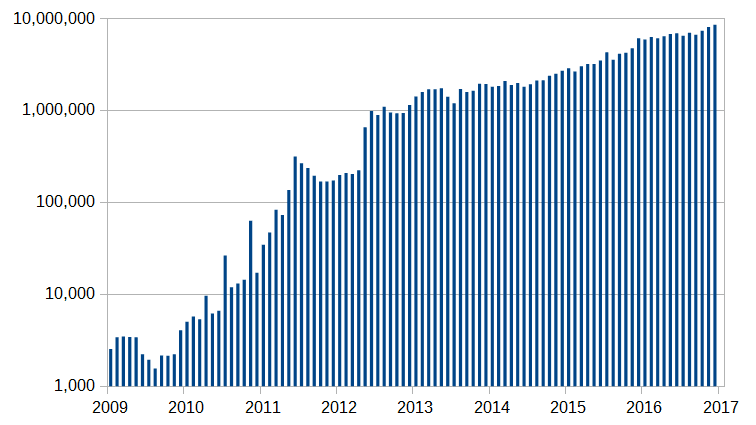
Why would Bitcoin limit the number of transactions the network can process?
Well, since Bitcoin uses a distributed ledger, every user on the network needs to download and keep a copy of the entire Bitcoin transaction history. Allowing unlimited transactions would mean that ledger would grow to an enormous size, and ordinary users wouldn’t have the computing storage or bandwidth to use the network.
If unlimited transactions were allowed, Bitcoin would become the domain of a centralized few organizations with enough processing power to handle tens of thousands of new transactions per second.
Since Bitcoin was created to avoid centralized institutions, this isn’t an attractive option.
The 1 MB limit on block size that’s currently in place means that the transaction ledger doesn’t grow too large too quickly. New users can easily download the transaction history and join Bitcoin. However, this block limit also means that there are more demands for transactions than there is space in the block to fit them all.
As a result, Bitcoin miners are charging fees to have your transactions prioritized and included sooner. If you decide not to pay the fees, as of November 2017, your transaction takes on average a little over 2 hours to get confirmed.
These fees and confirmation times also seem contrary to Bitcoin’s mission of democratizing payments. With fiat transfers, you pay fees to a bank. For Bitcoin, paying fees to miners doesn’t seem much different, although the fees are variable and usually less than a bank transfer.
The founders and community of Bitcoin Cash believe that block size does need a limit, but the 1 MB limit is arbitrary. Instead, they proposed a system with a block size of 8MB, still reasonable for new users to download but large enough that the new system could accommodate many times the number of transactions per second as the original Bitcoin blockchain!
Hard Fork: Bitcoin Alternatives and a Divided Community
Before deciding to create a new currency, the folks behind Bitcoin Cash appealed to the original Bitcoin community for an increase in block size. Those in favor of the increase cited greater accessibility and room to grow for the burgeoning Bitcoin user base.
However, there were many opposed to the increase, including miners who would miss the fees for transactions, leading to a decrease in overall mining on the blockchain and lowered security as a result. Opponents also believed that such an increase in network capacity would still lead to storage, bandwidth, and computing requirements outside the reach of the ordinary user.
While the two camps did reach a small compromise in the form of BIP 91 and Segregated Witness, upgrades targeted at reducing the amount of information needed inside the block, the argument over increased block size dragged on for over two years.
Ultimately the two camps decided to part ways in the form of a hard fork on the Bitcoin network.
The original Bitcoin would continue to exist with its 1 MB block limit. In addition, a new Bitcoin alternative, aka Bitcoin Cash, would be created with an 8 MB block limit. A hard fork means that Bitcoin Cash kept the same transaction history as Bitcoin up until the moment of the fork. If you owned Bitcoin before the hard fork, you continued to own that Bitcoin, but you now received an equivalent amount of Bitcoin Cash tokens on the new fork.
While technically almost identical, the two networks are not interchangeable.
The new Bitcoin Cash implemented replay protection and other measures to create a hard wall between the Bitcoin Cash fork and Bitcoin, meaning transactions could only be conducted within the fork and not across networks. The two currencies share a common history up until August 1, 2017, but thereafter they are completely separate.
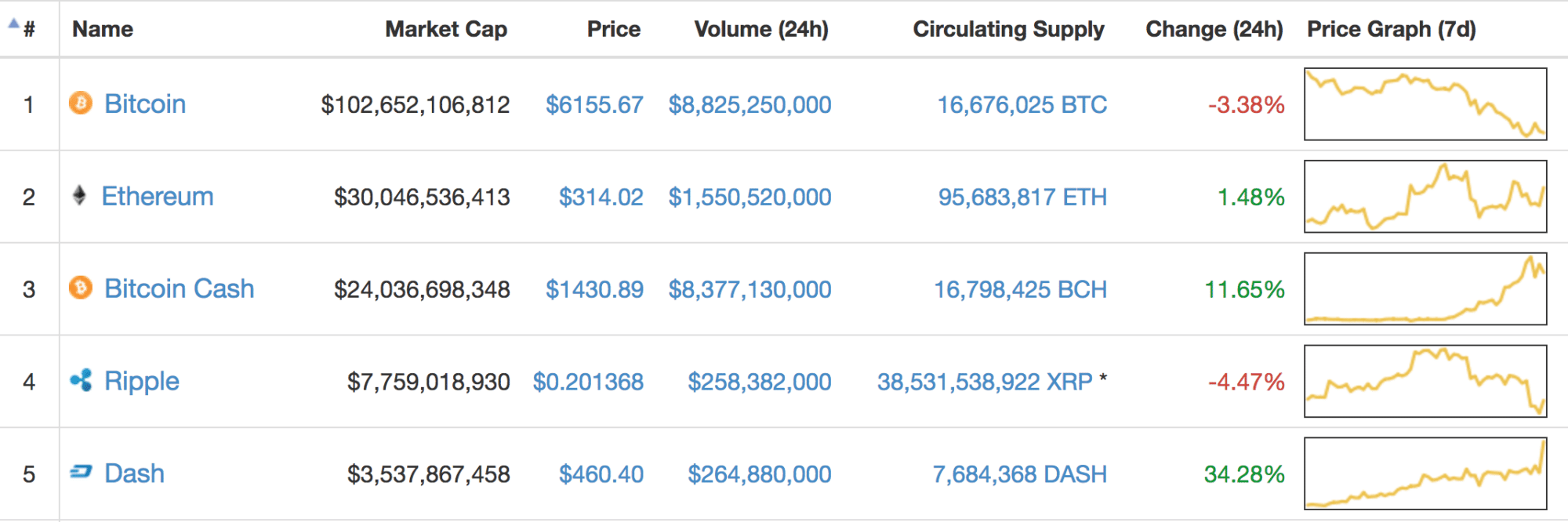
As a result, Bitcoin Cash has a different exchange rate than Bitcoin, and not all wallets and exchanges supported Bitcoin Cash upon its launch. Still, by the end of the day on August 1, Bitcoin Cash was the third most valuable cryptocurrency in the world, in terms of market cap, and it continues to hold that position as of November 13, 2017 (although it briefly passed Ethereum as the 2nd largest cryptocurrency by market cap).
For the beginning of its life, Bitcoin Cash largely derived its value from the speculation that it will inherit the throne as king of crypto if and when Bitcoin’s scalability crisis causes the currency to no longer be feasible. The most die-hard advocates of Bitcoin Cash believe it will simply become, “Bitcoin,” and the original Bitcoin will fade as Bitcoin Legacy.
Bitcoin Cash’s detractors, on the other hand, see the project as an unnecessary split to the community, dividing an already small core group of people who love and understand blockchain technology into factions.
The Miners: Whose Opinion Really Matters
At the end of the day, discussions on forums and social media about the future of Bitcoin and Bitcoin Cash are less important to the project’s success than the decisions miners make about the new currency.
Since Bitcoin Cash is almost identical to Bitcoin, aside from block size, the two forks would now be competing for mining power.
Miners had a choice: take a chance on a new, possibly lucrative venture with greater risk or stick with the tried and tested model on the original Bitcoin mining network.
In the beginning, Bitcoin Cash had trouble because its difficulty level was still calibrated to the mining power of the original Bitcoin network. With the sudden decrease in computing power for mining, it took up to 10 hours for Bitcoin Cash blocks to be mined early on.
However, Bitcoin’s (and, hence, Bitcoin Cash’s) software is written to adjust the difficulty of mining every 2,016 blocks. If more miners have joined the network, the difficulty will increase so the block time remains roughly the same (~10 minutes for Bitcoin and Bitcoin Cash). If there are fewer miners on the network, the difficulty will decrease.
The problem was that Bitcoin Cash didn’t have time to wait for 2,016 blocks to go by before the difficulty adjustment. Instead, they implemented an Emergency Difficulty Adjustment (EDA) that automatically changed the difficulty if the mining hashrate (hashrate is the computing power of all the mining computers on the network) is a tiny percentage of what was expected.
Over the first few weeks of Bitcoin Cash, the block difficulty dropped quickly thanks to EDA. As a result, mining Bitcoin Cash became more lucrative, and miners began to migrate from mining Bitcoin to Bitcoin Cash. Some of these miners were idealists, dedicated to the idea of Bitcoin Cash’s scalability solution. Yet, others were interested in acquiring Bitcoin Cash as an investment vehicle, with prices expected to rise. Finally, for some mining Bitcoin Cash was a business opportunity, and they’d switch between mining Bitcoin and Bitcoin Cash depending on which was most profitable at the time.
SegWit2x and the Current State of Bitcoin Cash
After its initial launch and pump of its value, Bitcoin Cash’s value stabilized around $400/BCH.
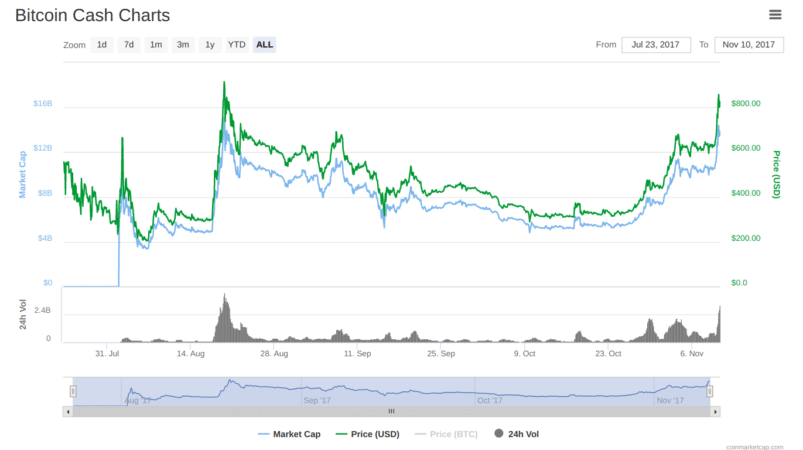
However, in recent weeks Bitcoin Cash has been on the rise, and news from November 9 about setbacks in Bitcoin’s scalability planning has only fueled the demand for Bitcoin Cash.
Bitcoin Cash is one answer to Bitcoin’s scalability problem, but the Bitcoin community was hard at work thinking of other ways to improve scalability. The first came with the implementation of Segregated Witness (SegWit), a new block structure that disassociated verification signatures from the transaction information contained in the block, reducing the space needed per transaction and increasing the transactions per block. SegWit was implemented as an optional, user driven update. This means that miners can choose whether to mine traditional or SegWit blocks. Once adoption reaches 95%, SegWit will be considered fully adopted. Currently, SegWit adoption is around 12%.
After SegWit went live, the next step in enhancing Bitcoin’s scalability was increasing the block size, not to 8 MB like Bitcoin Cash, but to 2 MB, effectively doubling the block size. This doubling was known as SegWit2x, and it was widely regarded as the way forward for Bitcoin, with users preparing for a hard fork to introduce the technology in November. However, a group of businesses and mining farms withdrew support for SegWit2x, essentially shuttering hopes for adoption of the scalability solution.
In the face of Bitcoin’s inability to establish a consensus on scalability, investors turned to Bitcoin Cash, with its price rising to over $1250/BCH in recent trading. If Bitcoin continues to struggle with its scalability issues, Bitcoin Cash is poised to take up the mantle. Investors in Bitcoin Cash believe that scenario is likely, while detractors believe Bitcoin’s dominance of the market will continue. Ultimately investing in and using Bitcoin Cash is about whether you believe Bitcoin’s scalability problems are serious and if you think Bitcoin can solve those problems.
Authored by Bennett Garner of CoinCentral.com